Santa Barbara & Montecito
The 2018 Montecito Debris Flow: Fire, Rain and Geology
Historical background from Drought & Flood by Michael F. Hoover, PG, CHG.
In the early hours of January 9, 2018, mud, boulders, and broken vegetation swept down the steep watersheds above Montecito. More than 100 homes were destroyed, and 23 people lost their lives. The destruction followed a fire that had burned through the mountains only weeks earlier.
In Drought & Flood, Michael F. Hoover examines the conditions that led to the disaster and the evidence of earlier debris flows beneath Montecito.
The burned watershed
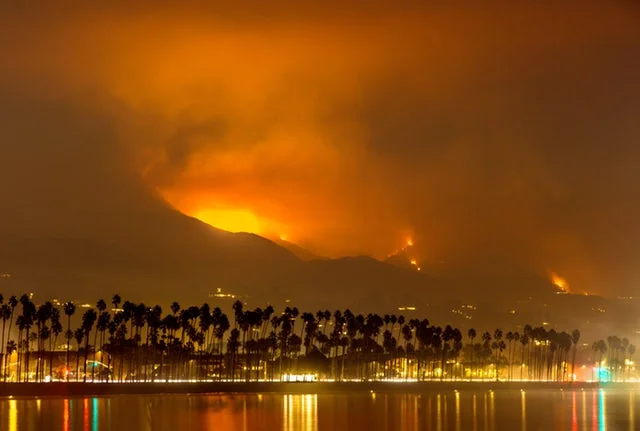
The Thomas Fire burned 281,893 acres in Ventura and Santa Barbara Counties in 2017, including much of the vegetation in the watersheds above Montecito. Many of those slopes had not burned since the Coyote Fire of 1964.
Drought makes vegetation drier and more susceptible to fire. After a fire removes that cover, a hillside is exposed when heavy rain arrives. The streams that ordinarily carry winter runoff can then receive large quantities of soil, rock, and vegetation from the surrounding slopes.
Rain in a matter of minutes
On the night of January 8 and into January 9, rain fell over Montecito and the mountains behind it. The book’s account records four inches in downtown Montecito, with more in the upper watershed. Within that storm, more than half an inch fell in five minutes.
The intensity of that brief downpour mattered as much as the storm’s total rainfall. Concentrated rainfall sent runoff down the recently burned slopes and into the canyons. As it gathered sediment and larger debris, the moving water became something far more destructive than an ordinary stream.
What the flow carried
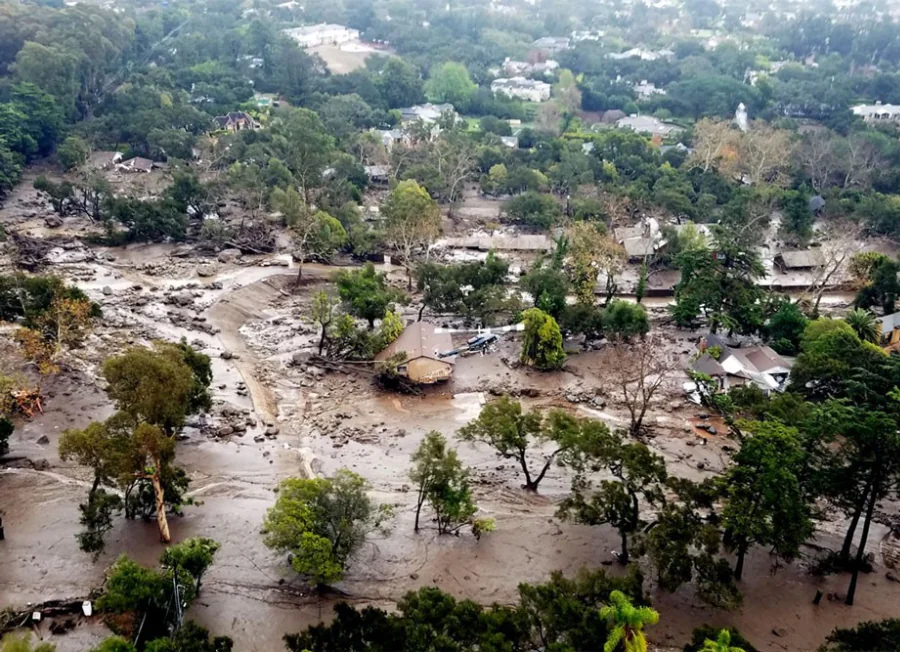
The event is often called the Montecito mudslide. The term “debris flow” describes the mixture that came down the canyons: water carrying mud, rocks, boulders, and vegetation. The solid material is central to understanding the damage.
Large boulders and debris were carried out of the mountain watersheds and into residential areas. The flows spread beyond the streambanks. Homes in their paths were destroyed or damaged, and US 101 was closed for several weeks.
Evidence beneath Montecito
Before 2018, geologists examining deep borings in Montecito had encountered evidence of ancient debris flows. Mud and large boulders had been deposited across areas well beyond the present streams. Those buried deposits showed that earlier flows had reached the coastal land on which the community was later built.
Historical floods, mudflows, and debris flows had also occurred in the region in 1862, 1914, 1964, 1967, 1969, and 1995. The 2018 event was especially destructive because of the combination of conditions in the watershed and the homes and roads in its path.
Knowing that earlier flows had occurred did not tell geologists when the next one would happen. The deposits preserved evidence of past events; they did not provide a date for the next severe storm after a fire.
Why the sequence matters
The Coyote Fire provides a useful comparison in Hoover’s account. It burned much of the Montecito watershed in 1964, but it was not followed by the extensive, intense rainstorm that arrived after the Thomas Fire. The presence of a burned slope alone did not determine the outcome.
In January 2018, the recent loss of vegetation, the intensity of the rain, the steep canyons, and the material available to be carried downhill came together. Looking at those conditions in sequence helps explain how a rainstorm became a debris-flow disaster.
The sediment and boulders beneath Montecito record earlier flows from the same mountains. Hoover’s account connects that geological evidence with the events of January 2018 and the landscape residents know today.
Read the full history
Drought & Flood follows the South Coast’s water history through drought, engineering projects, fire, and flood.
Order from UCSB Bookstore